
Securing a premium urban residence is merely the preliminary phase of establishing your sanctuary; the true complexity lies in its physical execution.
When you decide to hire an interior designer, you are not simply commissioning someone to select modular finishes and soft furnishings. You are selecting a structural partner who will govern your capital, dictate your daily timeline, and engineer the functional flow of your life. The market is overwhelmingly saturated, and properly evaluating Interior designers in Bangalore requires looking past glossy 3D visualizations and rehearsed sales presentations.
To protect your asset from timeline collapses, uncoordinated vendor friction, and hidden financial hemorrhage, you must approach initial consultations as rigorous operational audits.
Here is the definitive architectural interrogation matrix of ten precise, uncompromising questions designed to separate master builders from standard catalog decorators.
Assessing Spatial Intelligence & Execution Reality
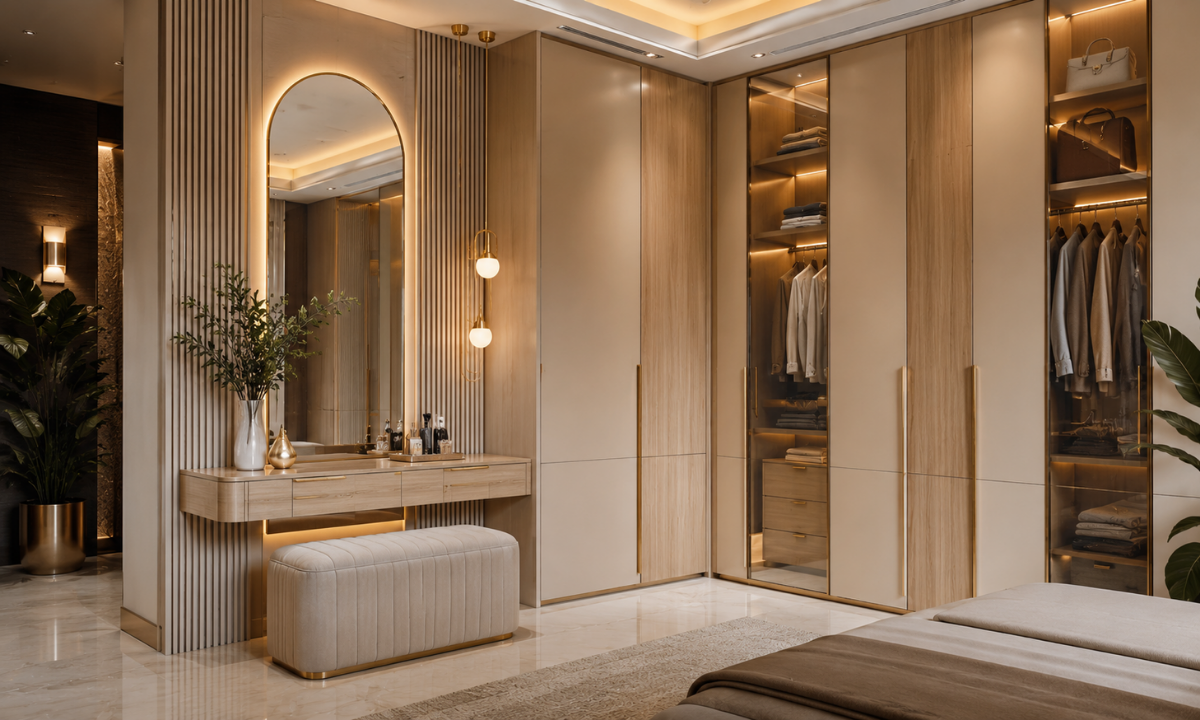
The most common trap in the premium mid-segment market is falling in love with a digital rendering, only to receive a compromised physical reality.
Many mass-market firms act as simple aggregators, forcing your unique floor plan into pre-fabricated, rigid dimensions. You must determine if the firm possesses true spatial intelligence or if they are simply assembling a catalog.
Question 1: Do you utilize rigid catalog templates or offer true custom modular engineering?
Standard modular agencies operate on fixed-size cabinetry (e.g., forcing standard 600mm or 900mm widths into your space). If your wall dimension is 1000mm, they leave a 100mm dead-space void, hastily covered by a filler panel.
Demand true custom modular engineering. A premium firm calibrates its core materials to the exact millimeter of your specific room, eliminating dead zones and increasing usable urban storage by up to 20%.
Question 2: How do you integrate my specific structural anomalies?
Every high-rise apartment or villa possesses structural quirks, awkward column placements, asymmetrical niches, or intrusive ceiling beams.
- The Decorator’s Answer: We can place a standard wardrobe in front of it to hide it.
- The Architect’s Answer: The firm should immediately discuss bespoke cladding, flush-to-wall integrations, or engineering a custom modular unit that wraps seamlessly around the column, utilizing the anomaly as an intentional architectural feature.
Question 3: How accurately does your digital vision translate to physical execution?
Never evaluate a firm based solely on high-resolution 3D renders. Renders are frictionless marketing tools; physical execution is the harsh reality. When reviewing an interior design portfolio, you must demand to see 3D Render vs. Final Execution side-by-side comparisons.
The Execution Reality Checklist
When examining a firm’s completed projects, look entirely past the soft furnishings and color palettes. Audit the physical engineering:
- Edge Banding Precision: Are the edges of the modular units completely seamless, or can you spot dark glue lines? (Visible glue lines indicate substandard factory machinery).
- Shutter Alignment: Do the wardrobe and kitchen shutters align with perfect millimeter precision, or is there a visible sag over time?
- Material Junctions: How flawlessly does the modular joinery integrate with the civil masonry, skirting, and flooring?
The Financial Transparency Audit
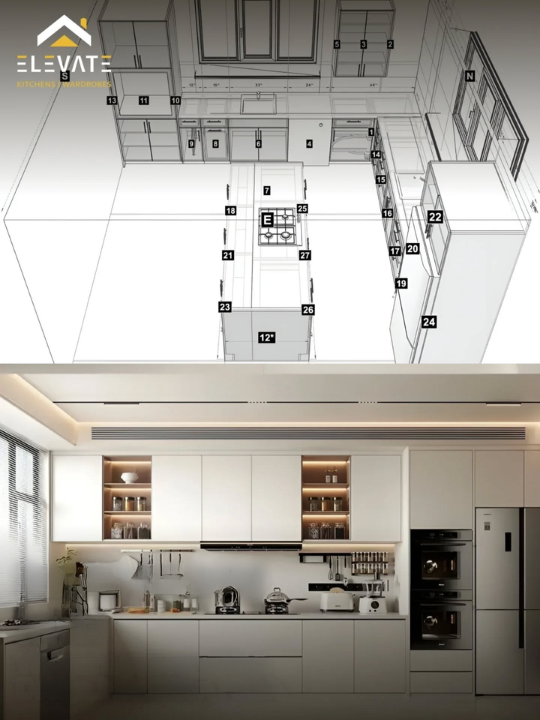
The most severe anxiety for any premium urban professional embarking on a residential project is the fear of uncontrolled financial bleed. In the unregulated residential market, agencies frequently weaponize opaque pricing structures. A beautiful design presentation is irrelevant if the financial architecture behind it is inherently flawed.
Question 4: Is your quotation a fixed-investment matrix or an open-ended estimate?
The most dangerous phrase in the industry is starting estimates. Mass-market agencies utilize artificially low initial quotes to secure a signature, only for the budget to aggressively inflate during execution due to vaguely defined site conditions or material upgrades.
Demand a fixed-investment matrix. This is a comprehensive, legally binding document where every hinge, channel, and square foot of engineered quartz is mathematically quantified and priced before a single drill touches your walls.
Question 5: How do you execute value engineering for my specific layout?
Value engineering (the strategic substitution of materials and methods to optimize costs without sacrificing the design intent or structural lifespan) separates true architectural partners from mere salespeople. If you need to optimize your capital deployment, a substandard designer will simply downgrade the quality of your core cabinetry.
A master designer will recommend maintaining the premium, high-density internal core while pivoting the exterior from a high-maintenance acrylic to a sophisticated, tactile laminate, preserving the structural integrity of the home while respecting your financial parameters.
Question 6: How do you protect against the fluctuating cost of interior design in Bangalore?
The local supply chain is volatile, with raw material costs shifting constantly. When evaluating the cost of interior design, explicitly ask the firm who absorbs these fluctuations once the contract is signed.
A premium execution partner locks in the material rates and factory production costs the moment the agreement is executed, shielding you from sudden price hikes. If the firm relies heavily on decentralized third-party carpenters or external vendors, the client will inevitably end up absorbing those inflated costs and material shortages.
The Financial Model Comparison
To protect your asset, cross-examine the firm’s commercial proposal against these two distinct operational models:
| Financial Metric | The Rough Estimate Trap (To Avoid) | The Fixed-Investment Matrix (To Demand) |
|---|---|---|
| Initial Quote Strategy | Artificially low; designed purely to win the pitch. | Realistic, comprehensive, and mathematically data-driven. |
| Material Specifications | Vague generic descriptions (e.g., Commercial Plywood). | Exact brand, thickness, and ISO structural grading specified. |
| Operational Friction | Client pays for vendor delays, errors, and material wastage. | Capital is locked; the firm absorbs all on-site execution friction. |
| The Final Invoice | Typically, 20% to 40% higher than the original pitch. | Exactly matches the initial signed agreement. |
Project Management & Timeline Sovereignty
For the premium urban professional, time is the ultimate unrenewable asset. The psychological exhaustion of managing a residential project stems directly from operational delays, endless site visits, and the financial drain of overlapping rental leases. A sophisticated design presentation is rendered entirely useless if the physical handover stretches months beyond the initial promise.
Question 7: Who holds singular, day-to-day site accountability?
The standard industry practice is to add the homeowner to a chaotic digital messaging group filled with disparate electricians, plumbers, and carpenters. This forces you into the role of an unpaid general contractor, constantly mediating disputes and resolving on-site friction. Demand singular accountability.
You must ask the design firm if they deploy a dedicated, in-house Project Manager who acts as your sole node of communication. This professional must be strictly responsible for governing the site, enforcing quality protocols, and ensuring flawless synchronization between the factory production line and the physical installation.
Question 8: What is the mathematical guarantee of your handover date?
Never accept verbal assurances, optimistic targets, or vague approximations regarding your move-in date. The traditional interior design timeline is notoriously fluid, continuously plagued by supply chain excuses and uncoordinated labor schedules. A premium execution partner does not deal in estimates; they operate on strict, mathematically driven delivery schedules.
The Execution Timeline Audit
To ensure your move-in date is fiercely protected, interrogate their project management framework using these specific checkpoints:
- The Factory-to-Site Ratio: Does the firm manufacture 80% of the interior off-site in a highly automated, precision facility? Maximizing factory production minimizes on-site dust, noise, and timeline bloat, leaving only the final 20% for rapid, surgical assembly at your property.
- The Contingency Buffer: How does the firm handle unforeseen civil delays? A master builder maps out a critical path schedule before execution begins, identifying exact buffer days for curing, drying, and testing.
Is the firm confident enough in its operational infrastructure to offer a legal handover guarantee? If they miss the promised date, are there contractual penalties they must absorb?
Longevity, Materiality, & Post-Handover Protection
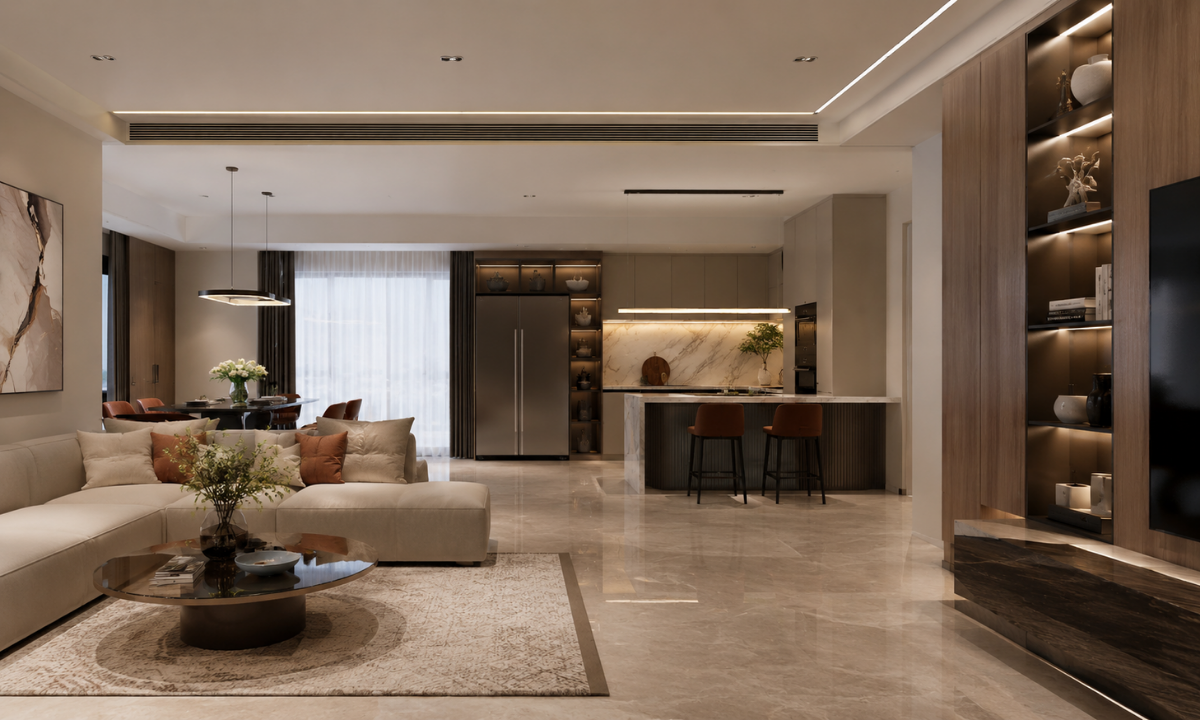
The aesthetic finish of a space is only as valuable as the structural core beneath it.
When evaluating Home interior designers in Bangalore, their commitment to your asset must extend far beyond the final handover day. A premium space must absorb the friction of daily urban living without degrading. You must interrogate the engineering standards and the legal protections anchoring the project.
Question 9: What is the exact structural grading of your modular core materials?
Standard decorators focus entirely on the external laminate or acrylic finish. However, the lifespan of a culinary stage or bespoke wardrobe is dictated entirely by its internal substrate.
Do they rely on low-density particle boards that swell rapidly upon contact with moisture? Or do they engineer wet zones utilizing high-density, Boiling Water Proof (BWP) grade plywood? You must demand technical specifications regarding the core density and the specific hinge-holding capacity of the materials to ensure cabinet doors do not sag or detach after a single year of operation.
Question 10: What is the precise, legal scope of your post-handover warranty?
A verbal assurance of future support from an unorganized contractor holds zero operational weight. A true architectural partner provides a formalized, legally binding warranty document that protects your capital.
You must ask explicitly: Does this warranty comprehensively cover hardware malfunction, material delamination, and factory manufacturing defects? Furthermore, determine if they manage an in-house service department. If a firm relies on decentralized third-party vendors for maintenance, your service requests will inevitably be lost in a continuous cycle of shifted blame.
The Substrate and Support Mandate
Before signing an agreement, verify that the firm adheres to these baseline longevity standards:
- Engineered Moisture Defense: Strict utilization of BWP/BWR core substrates in all high-moisture zones (kitchens and bathroom vanities).
- Hardware Superiority: Integration of premium, load-tested European hardware (such as Hettich or Blum) engineered for hundreds of thousands of fluid open-close cycles.
A dedicated, centralized maintenance protocol that dispatches internal technicians rather than outsourcing your repairs to external carpenters.
Why Choose Elevate Interio? The Elevate Interio Standard: Practical Luxury, Delivered
When executing a premium residential project, you do not need an agency that merely curates furniture; you need an architectural partner that engineers solutions. Elevate Interio occupies a unique space in the market: we offer the sophisticated design language of a bespoke firm combined with the rapid execution capability of a highly automated modular agency.
We answer the architectural interrogation with absolute operational transparency:
- Rapid Turnkey Mastery: A strict, mathematically driven 45-day handover guarantee. We do not deal in estimated timelines; we execute with absolute precision.
- Accessible Premium Execution: High-end, personalized architectural solutions starting at a transparent 15 Lakhs investment, with a comprehensive fixed-investment matrix and zero hidden project management fees.
- Intelligent Modular Engineering: No rigid catalog templates. Our factory infrastructure customizes the core cabinetry to the exact millimeter dimensions of your floor plan, unlocking maximum spatial utility in urban environments.
A formalized, comprehensive warranty anchored by our own in-house service department, guaranteeing the structural integrity of your investment long after the handover.
Conclusion
A home should be a source of solace, not a site of operational anxiety. By asking the right questions, you shift the power dynamic from the agency back to the homeowner, ensuring your capital is protected and your timeline is respected. Moving from a digital concept to a physical reality requires precision engineering, robust project management, and uncompromising material truth.
We invite you to step beyond the digital screen. Visit the Elevate Interio Experience Centre to interact with our high-density substrates, test our engineered hardware, and discover exactly how practical luxury feels in reality.